
Why do we “slow down” to fly?
By Yen · Originally published on Yen’s Voice.
Yen
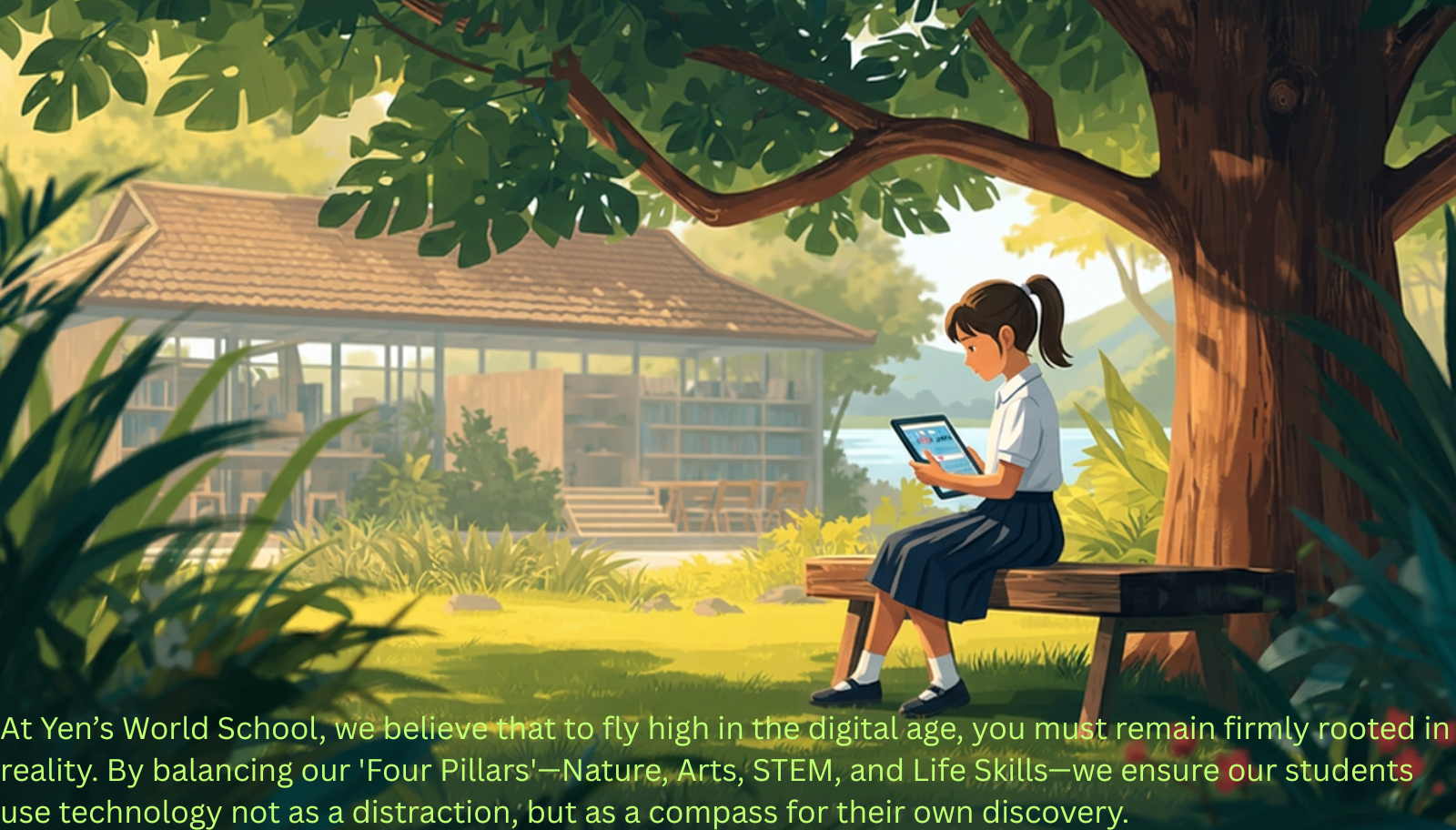
In an era where technology promises instant answers, our instinct at Yen’s World School (YWS) has been to hit the pause button.
Philosopher Gert Biesta warns us that education is not about efficiency—it is about "coming into the world" as a thinking, moral individual. If we allow AI to provide every answer, we risk raising a generation of passive consumers rather than active creators. This is why we developed our "AI-ON" pedagogy. It is not just about bringing technology into the classroom; it is about teaching our students to "train the machine" rather than letting the machine train them. Why We "Slow Down" to Fly.
On one of my daily visits to our Yen’s World School, I came upon a scene that delighted me. During craft time, children were handed an open invitation: “Here you have materials, craftpaper, glue, paper cups and sticks. During this hour, you can make anything you want to make.” There was no example on the blackboard, no correct version waiting at the end. What would have looked like a simple craft class became a real encounter with freedom.
Such a task is much harder than being told what to do. It’s being confronted with your own freedom, when you need to figure out what to do if no one tells you what to do.
Schools prioritize speed, efficient learning, and measurable outcomes. And frankly nothing has done more to minimize that space than AI – a machine designed to hurry.
At Yen’s World School, we are rigorous about maintaining a balance between the digital and the physical. Our students start their day at 9:30 AM with prayer, followed by warm-up exercises and yoga. These are not just "activities"—they are our grounding rods. When a child learns the discipline of a yoga pose, they learn that physical reality resists us and does not yield to a prompt.
Our "Four Pillars" approach—STEM, Nature, Arts, and Life Skills—ensures that when our students use AI, they are doing so from a foundation of reality. Whether they are learning to create a game in ‘Scratch’ or analyzing data, they are the ones in the pilot’s seat. We teach them to be "doubt-prone." When an AI gives an answer, our students are being coached to ask: “Is this biased? Is it accurate? Is it human?” Real-World Lessons in the Digital Landscape.
Integration is rarely smooth, and we celebrate the bumps in the road as part of the curriculum. We don't hide these challenges from our staff or students, rather we use them to navigate the "stormy seas" of the modern information age. The Courage to Believe.
As I have often written about in my own journey, faith and belief are not found in a supermarket. They are discovered within. We see this daily in our students. We are currently working on projects like developing a dedicated customised web application to calculate carbon footprints of children, proving that we can use the power of modern tech to serve our environment and our future.
We are not just training children to survive the future; we are training them to shape it. We are teaching them to align with the "ceaseless rhythm of the cascade," using technology to find the river that leads to the open sea.
Here is how we align with the enduring principles of Gert Biesta
|
Philosophical Need (Biesta) |
YWS "AI-ON" Implementation |
|
Slowing down the learning flow |
"Training the Machine": Students must curate data, which inherently slows down the process. |
|
Hesitation & Judgment |
"Questioning the Output": Students are coached to verify/fact-check every AI claim. |
|
Sense of Duty / Conscience |
Ethical AI Modules: Explicit training on identifying deepfakes and algorithmic fairness. |
|
Resistance of Reality |
4 Pillars Pedagogy: AI is integrated with physical Nature, Arts, and Life Skills projects. |
I can do all this work for you
Language models can speed up tasks, and can generate mostly sensible output that can be incredibly convenient. But classrooms using AI need something more competitive – they need some friction. Students who let AI write their essays risk ceding their intelligence and effort to a system that moves quickly toward a predescribed outcome. The faster the students go, the fewer the opportunities for hesitation, judgment, and eventually any meaningful learning.
These are the moments that matter most for us at Yen’s World School, because we want to make a student stop, sit with not-knowing, and face the deeper question, What should you be asking for when everything’s at your fingertips. What’s wise to pursue?
AI can’t answer those types of questions meaningfully, which is one reason why we prefer not to view it as a one-size-fits-all solution to problems, but rather more narrowly as a tool. If a carpenter had just one tool – a hammer, and he thinks it can do everything, he obviously is not a good carpenter.
Above all AI invites dependency, making it a highly addictive technology, and therefore, it easily sucks you in and then makes you forget yourself.
Take social media like Instagram or Tiktok, to generative AI. They all can feel fast and immediately gratifying that it can be difficult to pause and contemplate what you’re viewing or how you’re interacting with the technologies. Before you know it, you’re inside it.
The challenge is to remain in a relationship with everything the world offers without losing oneself. In education, this means helping students develop and preserve the capacity to stop and ask, “Should I be doing this?”
Animals and machines
Machines can make certain types of judgments very correctly for sure – the ones that work by rules and decision trees. “If this, then that”. A machine can do this very well. Modern language models are even more complex, operating on probabilities rather than strict rules. Yet beyond a certain point, there is a whole dimension of judgments that cannot be reduced to such procedures. This kind of judgment has to do with a sense of duty, not simply choosing between options, but reflecting on the stance and direction one should take.
Long before the explosion of generative AI, the affluent west used a simple machine – a robot vacuum cleaner. Put it in a room once, and it bumps into table legs, sofa corners, walls, perhaps even a pet. Send it through the same room again, and it adjusts its route, becoming more effective and intelligent in navigating the space. But what the robot vacuum cleaner can never do is to judge whether the room it is put in is a room worth cleaning or not. More than that, it cannot ask what kind of world its efficiency is serving. Indian metros are seeing plenty of robot vacuum cleaners.
This is not to say that machines do not learn. Learning means that AI systems can adapt to situations they are in, and they can become better and quicker at adjusting. But for us, clearly, moral awareness lies outside the scope of learning. This is also where the human being stands apart from both intelligent animals and machines.
The ancient Confucian philosopher Xunzi said: ‘Birds and beasts have intelligence but no sense of duty’. We can add machines too to the list. AI imitates moral awareness, through clever programming, but it cannot arrive at judgments. We, by contrast, can have a sense of duty. 'What should I do?’ is always a question for us.
This is why we insist so strongly that learning is not the point of education. It appears that certificates and degrees acquired through learning are the goal for most of us. For me, this is a confusing paradox of contemporary educational policy. People say, ‘The school is a place for learning,’ or ‘The job of a teacher is to make students learn.’ If you want to learn, you don’t need a school or a teacher; you will learn an awful lot by being on the street or being an apprentice at sea, as I did.
Intelligence adapts, conscience interrupts.
For us at Yen’s World School, the ultimate purpose of education is rather counterintuitive and provocative – to disturb the flow of learning, to stand it on its head. Education should raise the question – “What will you do with what you have learned?” Without such interruptions, learning can leave us bequeathed with many A++ grades and fancy degrees, yet be morally asleep.
That’s why we define ourselves as an “Unschool”
To help students remain with these moments of slowing down, interruption, and thoughtfulness, we use specific techniques. One is reflective contemplation. An example is the familiar essay. Students can easily become fluent in essay writing without embedding a core moving narrative. So we can replace the familiar question, “What have you learned?” with a harder one: “Can you describe how you’ve been in a situation?” — a question that hopefully draws students back into the living encounter itself.
Keep the pain awake
What we are hoping to protect is a sense of “self-uncertainty.” When people are very certain of themselves, they become dangerous, because they no longer carry the possibility of doubt about their own actions. That small, uncomfortable space of self-uncertainty is the very basis of moral consciousness. It becomes a kind of double knowing. You do not merely act as an intelligent organism, but enter into a reflective relation with yourself. You watch yourself act. And as you move ahead, you ask whether you should be moving ahead at all.
It is extremely demanding work to keep this moment of doubt alive. Yet this is what it means to lead a human life. To carry within yourself the recurring question: “Hey, wait a minute — is this going the way it should be going? Am I being pulled into a meaningful direction?” It is a life practice, something one must do again and again.
Biesta warns against educators who think they should help young people become certain of themselves and help them find their identity. “What education can do instead is practice a pedagogy of interruption, not telling the young how to live, but correcting their stance and interrupting their direction of travel, troubling their familiar ways of being and doing, so that hesitation remains possible.”
Biesta quotes Martin Buber’s (the famous Austrian Israeli philosopher) striking phrase, “The first task of educators in our time is to keep the pain awake.” That pain, Biesta said, is the pain of conscience, the difficulty of regularly asking whether one is going in the right direction.
The encounter with the real
As thought researchers, we often wonder how we can help one another keep moments of hesitation and thoughtfulness alive, not just in children, but also in adults living in a society that pulls us in multiple directions. One answer is to fill our lives and the lives of our children with real things. Reality is not programmed to give us exactly what we want, and that is its gift. It interrupts our flow. It slows us down. It makes hesitation possible.
A modern challenge is that we no longer know what truth is — with overwhelming fake news and curated narratives around us. Another crisis has to do with our sense of what is real. AI is part of that crisis. It has unsettled the world of images, which many once trusted as being windows into reality. Technology crowds life with the virtual immersive digital world. You can create images of anything you can think of. But then it all has to come from your thinking, and the material doesn’t help you to see that not everything you can think is actually meaningful to do.
This drift away from the real, belongs to a larger modern cultural pattern. We have organized life in much of the developed world around getting what we want quickly and efficiently — like shopping and instant delivery. We never take the time to ask what is worth wanting at all.
The encounter with what is real, is different. When you encounter stuff that is real, it offers resistance. It doesn’t allow you to do anything you want to do with it. A garden teaches this well. Plants grow at their own pace, and trying to force them often destroys them. More challenging still is the encounter with another human being, who will not necessarily do what we want. Sometimes this becomes unmistakable in the life of a parent, when your child turns and says, “No, I’m not going to do this!” In that moment, you meet a reality that refuses your script. You cannot simply press harder and get your way.
That is why we at Yen’s World School surround children with pristine nature, gardens, animals, and real world things. Our permanent new space embodies this in letter and spirit. It's rare to have ‘Nature’ stand as an equal vertical as STEM in a K12 curriculum. If everything becomes textual and virtual, we lose one of the few remaining powers that can still stop us in our tracks and call us back to ourselves.
If you are a parent or educator looking for a space where curiosity is honored and critical thinking is the primary tool, we invite you to be part of this journey at Yen’s World School.
Join us as we continue to rise—not by letting AI lead, but by leading the AI.
Yen
Call us at +91-9995510794 / 8891510794